Most businesses evaluating AI agents ask the wrong first question. They ask what the agent can do. The better question is what the agent should be allowed to do without checking first.
That distinction is the difference between a demo and a system you can actually run in production. A demo looks impressive because it completes a task end to end. A production system has to handle the version of that task where the data is incomplete, the request is ambiguous, or something downstream depends on the answer being correct.
This is where most agentic AI projects break down after launch. Not because the model was not smart enough, but because nobody designed what happens when the agent is uncertain.
The Core Problem With "Just Let The Agent Decide"
Large language models are very good at sounding confident. That is exactly the risk in a business context.
An agent that is asked to check calendar availability, validate a customer request, or update a record will produce an answer whether or not it actually has enough information to be right. It does not pause by default. It does not flag uncertainty unless you build that behavior into the system.
For a chatbot answering general questions, an occasional wrong answer is annoying. For an agentic AI system connected to your calendar, your CRM, your inventory, or your billing, an occasional wrong answer is a real operational cost. A missed booking. A duplicate record. A customer told something that was never actually confirmed.
The fix is not a smarter model. The fix is architecture.
Verification Is A Design Pattern, Not A Feature
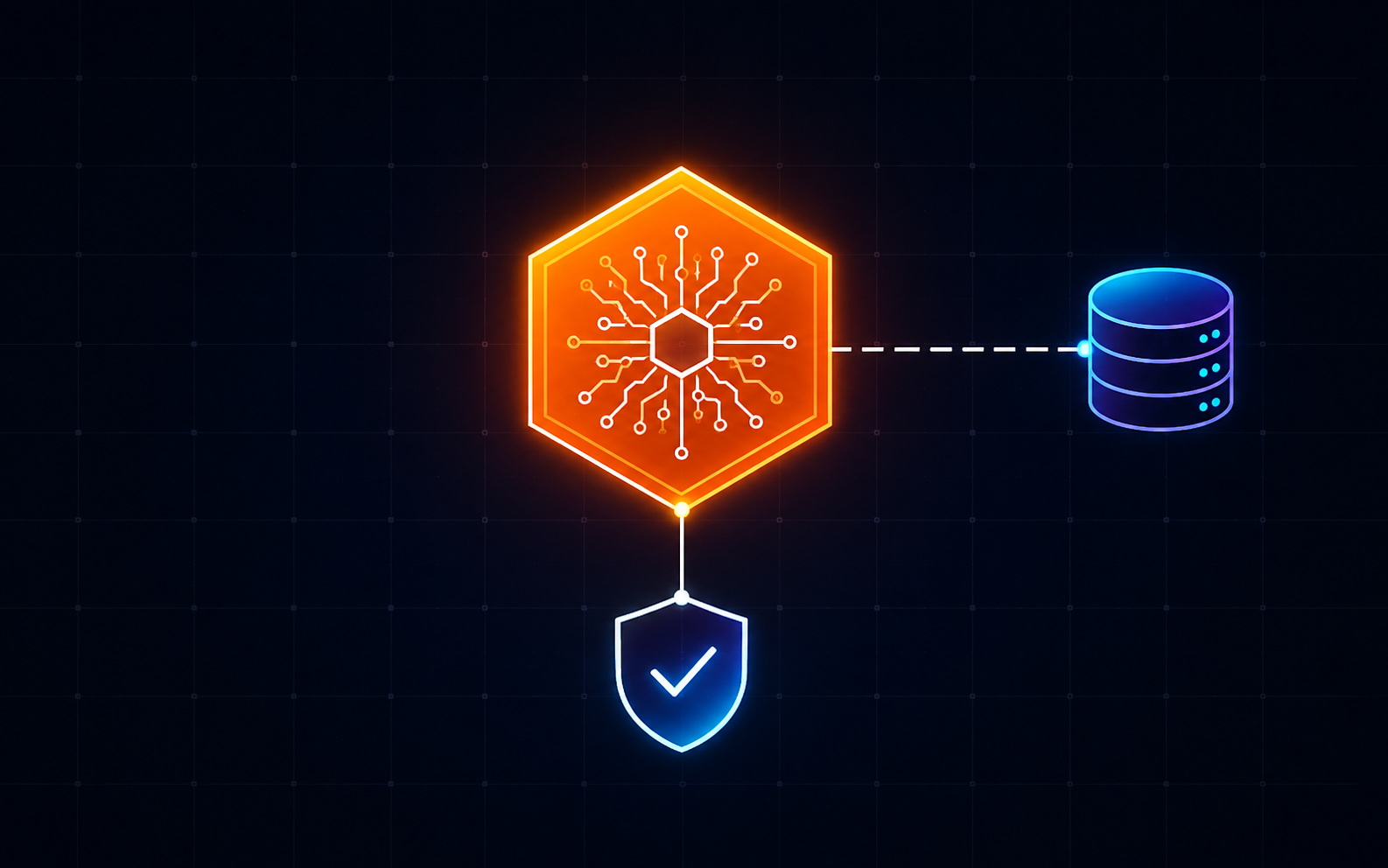
When people talk about making AI agents safer, the conversation usually jumps straight to guardrails or prompt engineering. Those help, but they are not the foundation. The foundation is designing the workflow so the agent has to check reality before it commits to an action.
1. Separate Reasoning From Action
A well built agent should not be allowed to reason and act in the same uninterrupted step when the action has real consequences. Reasoning happens first. The agent proposes what it believes should happen. Then a separate step validates that proposal against the actual source of truth, whether that is a live calendar, a database record, or a business rule.
This separation sounds simple, but it is the single biggest reliability improvement you can make to an n8n or LangGraph based workflow. It turns "the agent said this is available" into "the agent said this is available, and the system confirmed it against the real calendar before booking."
2. Validate Against The Source Of Truth, Not The Model's Memory
An agent's internal reasoning is not a database. It is a prediction. If your workflow lets the agent act purely on what it inferred from the conversation, you are trusting a guess over your actual records.
Every action that changes something real, a booking, a status update, a payment trigger, should pull a fresh check from the actual system of record immediately before executing. This is slightly slower than letting the agent act instantly. It is also the difference between a system your team trusts and one they quietly stop relying on after the third mistake.
3. Build In Human-In-The-Loop At The Right Checkpoints
Full autonomy sounds appealing until you consider what a wrong autonomous action actually costs you. The better target for most businesses is not zero human involvement. It is human involvement at the moments that carry real risk, while the agent handles everything repetitive around those moments.
A practical way to think about this: let the agent gather information, cross check it, and prepare the action automatically. Require a human confirmation only at the step where a mistake would be expensive, like a refund, a contract term, or a final scheduling commitment. This keeps the system fast without removing the safety net where it matters most.
4. Design For "I Do Not Know" As A Valid Output
Most agent failures are not the agent doing something wrong. They are the agent doing something confidently when it should have said it was not sure.
This has to be designed on purpose. Give the agent explicit permission, inside its instructions and its available actions, to stop and ask instead of guessing. An agent that can say "I do not have enough information to confirm this" and hand off to a human is more valuable than one that always produces an answer, because the second one will eventually produce a wrong one at the worst possible time.
What This Looks Like In A Real Workflow
Take a common use case: an AI agent handling inbound booking requests for a service business.
A naive version reads the request, checks a rough sense of availability from context, and confirms the appointment directly. It works in a demo. It breaks the first time two requests come in close together, or the calendar has an exception the model was not aware of.
A production version separates the steps. The agent reads the request and extracts intent. A dedicated step then queries the actual calendar system directly, not the agent's assumption of it. Only after that check passes does the agent proceed to confirm, log the booking, and send a response. If the check fails or returns ambiguous results, the workflow routes to a human instead of guessing.
The difference is not visible to the customer in the happy path. It is entirely visible the first time something does not go as expected, which is exactly when it matters.
Why This Matters More As Agents Get More Capable
There is a tendency to assume that as models improve, this problem goes away on its own. It does not. More capable models produce more confident, more fluent, more convincing wrong answers when the underlying data is missing or ambiguous. Capability and reliability are not the same axis.
The businesses that get real value from AI Employees rather than fragile automations are the ones that treat verification as a required part of the architecture, not an afterthought bolted on after something breaks. It costs a bit more design time upfront. It is what allows a system to actually be trusted with real operations instead of staying a proof of concept.
If you are evaluating an agentic AI build for your business, the right question to ask a builder is not "can it do this." It is "what happens when it is not sure." The answer to that question tells you whether you are getting an automation you can lean on, or one you will end up double checking manually anyway.
This is the kind of architecture work behind custom AI agent builds, and it is also the lens worth applying to any AI project before it goes live, not after it fails once. If you are exploring what this could look like for your own operations, feel free to get in touch.